Allergy Season Email Marketing: How Wellness Brands Can Use Weather Triggers in Klaviyo
Allergy season isn't a date on the calendar — it's a weather event. Pollen levels rise as temperatures increase in spring and fall when the first cold nights arrive. UV index climbs in summer. Humidity spikes trigger mould and dust mite flare-ups. All of it is forecastable. All of it is automatable.
For wellness brands selling antihistamines, supplements, nasal sprays, or allergy-relief products, this is one of the most reliable trigger categories available.
The weather profile properties to use
Weather for Email doesn't currently sync a dedicated pollen count property — but pollen behaviour is closely correlated with properties that are available:
wfe_forecast_max_temperature_c— pollen counts rise sharply when daytime temperatures exceed 10–12°C in spring. Temperature crossing this threshold is your primary allergy season trigger.wfe_average_uv_index— high UV days tend to correlate with high pollen conditions (dry, sunny, warm). UV above 5 combined with warm temperatures is a strong proxy for high-pollen days.wfe_current_weather_condition—Sunny or ClearandPartly Cloudyconditions typically accompany higher pollen dispersal.Rainwashes pollen out of the air — useful for suppressing sends.wfe_forecast_chance_of_rain— rainy forecasts mean lower pollen. Use as a flow filter: ifwfe_forecast_chance_of_rainis above 60%, suppress allergy campaign sends.wfe_forecast_min_temperature_c— cold overnight temperatures suppress pollen in late spring. As min temperatures rise above 5°C, the pollen season is fully underway.
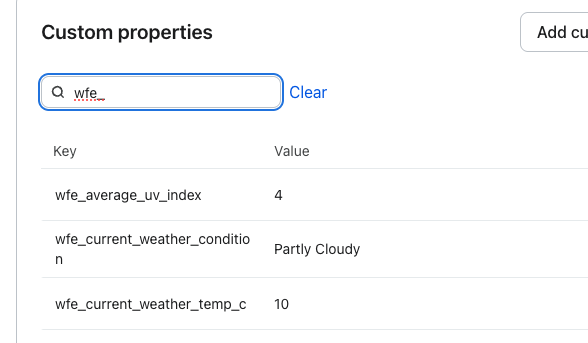
Example of some weather profile properties
4 campaigns to build
1. Spring allergy season opener
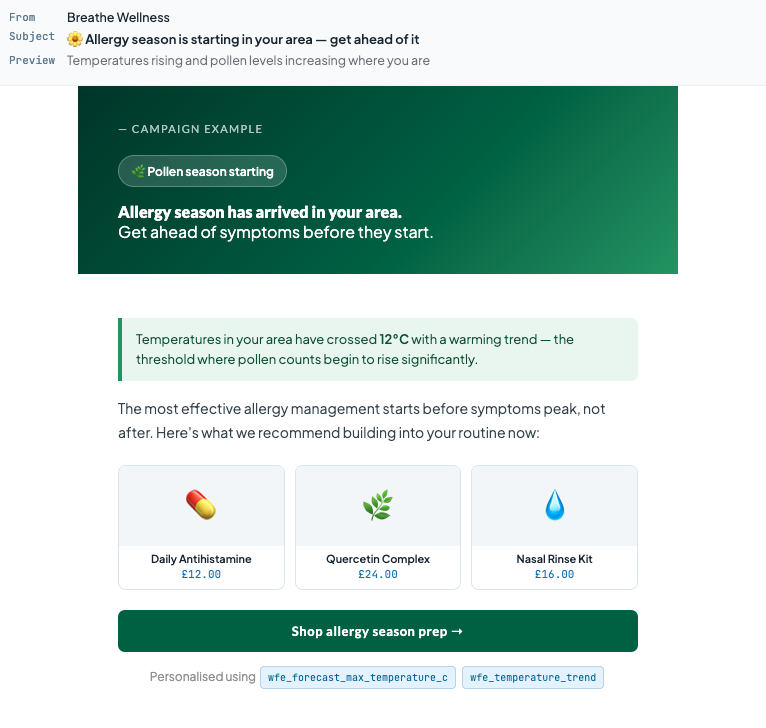
Trigger when wfe_forecast_max_temperature_c first crosses 12°C in spring AND wfe_temperature_trend is Warmer or Much_Warmer. This is the pollen season starting line — different for every customer's location, automatic for every profile.
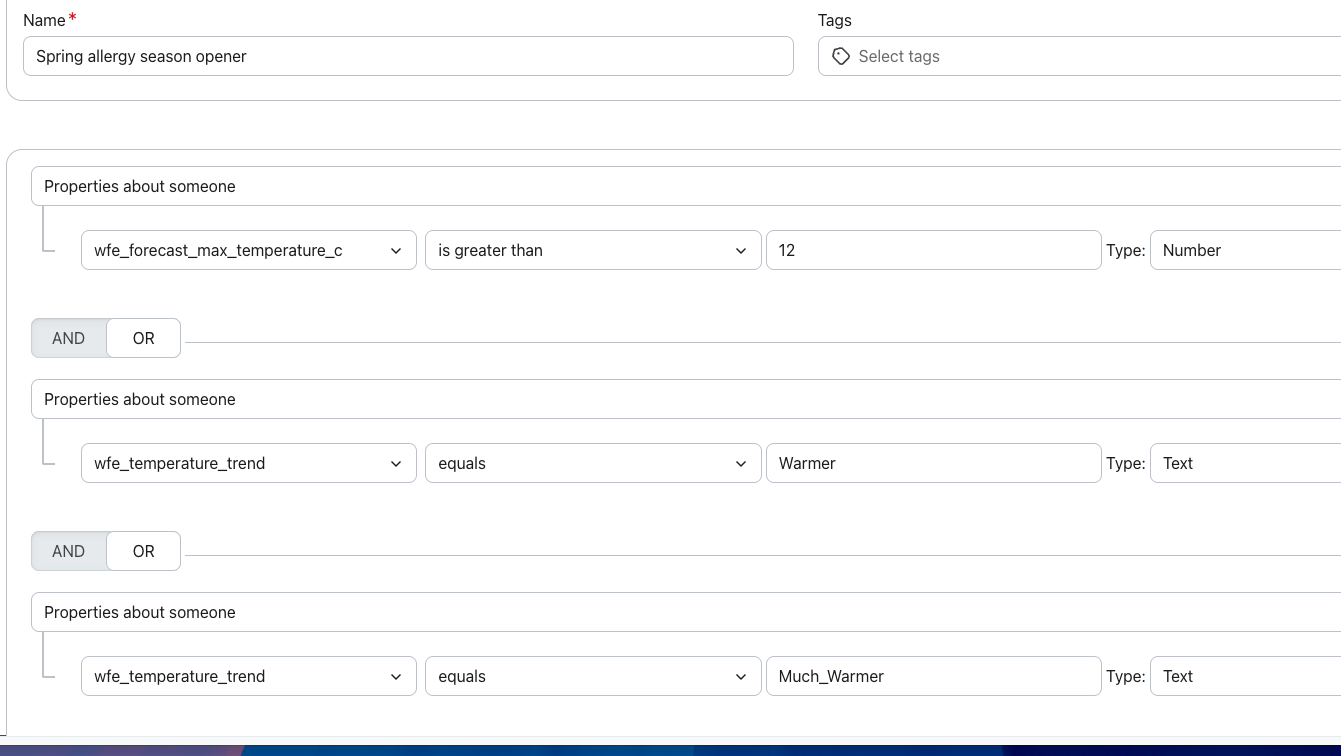
Campaign angle: preparation and protection. "Allergy season is starting where you are — here's how to get ahead of it." Antihistamines, nasal rinses, immunity supplements, air purifiers.
2. Peak pollen days campaign
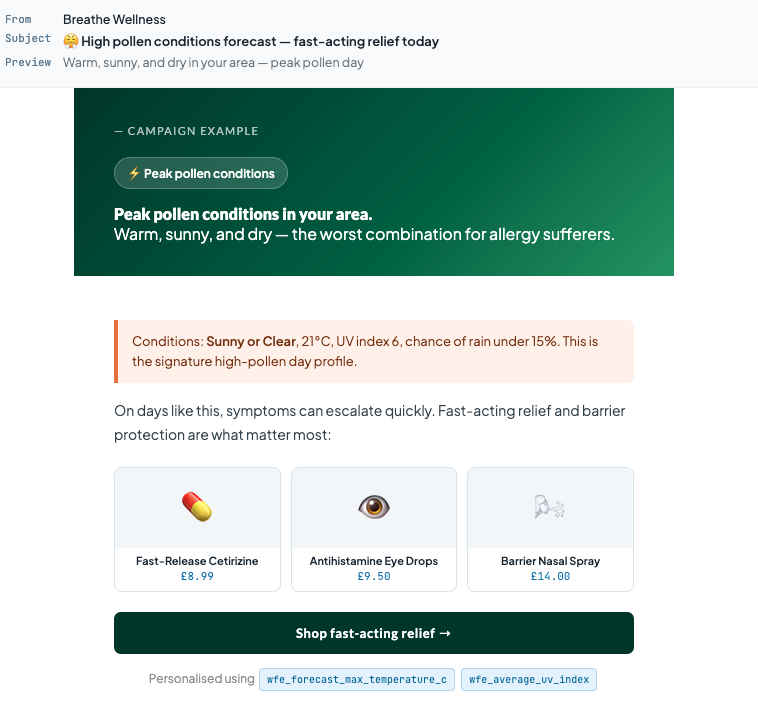
Build a segment combining wfe_forecast_max_temperature_c above 18°C + wfe_average_uv_index above 5 + wfe_forecast_chance_of_rain below 25%. This is the signature high-pollen day profile: warm, sunny, dry. Target customers in this segment with fast-acting relief products — oral antihistamines, eye drops, nasal sprays.
Subject line example: "Warm, sunny, and dry in your area — high pollen conditions forecast"
3. Rain suppression filter
Rain washes pollen out of the air. On rainy days, allergy sufferers typically get some relief. Use wfe_forecast_chance_of_rain above 60% as a suppression filter on all allergy flows — customers don't need antihistamine messaging when the pollen is being rained out.
This one detail makes your campaigns significantly more accurate and prevents you from looking out of touch.
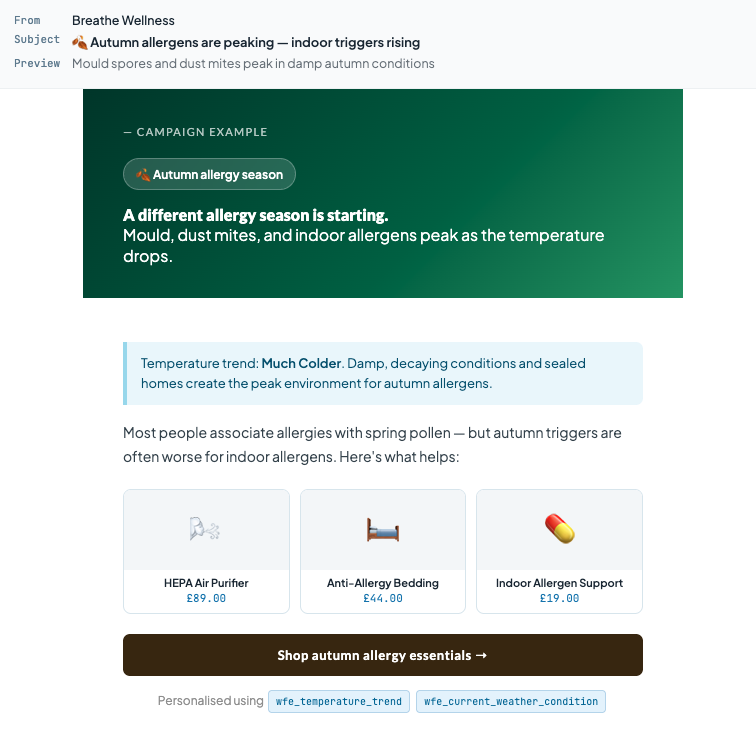
4. Autumn allergy campaign
Mould spores and dust mite allergens peak in autumn — damp, decaying leaves, warm houses sealed up for winter, fluctuating humidity. Trigger when wfe_temperature_trend flips to Colder and wfe_current_weather_condition includes Rain or Mist or Fog. Products: air purifiers, anti-allergy bedding, indoor environment supplements.
Dynamic content example
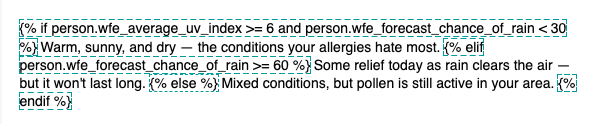
Use wfe_average_uv_index and wfe_forecast_chance_of_rain together to tailor the email message:
{% if person.wfe_average_uv_index >= 6
   and person.wfe_forecast_chance_of_rain < 30 %}
  Warm, sunny, and dry — the conditions your allergies hate most.
{% elif person.wfe_forecast_chance_of_rain >= 60 %}
  Some relief today as rain clears the air — but it won't last long.
{% else %}
  Mixed conditions, but pollen is still active in your area.
{% endif %}
Why you need Weather based triggers for your marketing
Allergy triggers are hyperlocal and seasonal — exactly the kind of signal that generic calendar-based email misses entirely. A customer in the South East of England may be two weeks into hay fever season before a customer in Scotland has seen a single symptom. Sending a national "hay fever season is here" email on a fixed date is wrong for a large portion of your list.
Weather-triggered email handles the geographic variation automatically. Each customer is reached when conditions match their location — not when your promotional calendar says spring has started.
