Why Weather Is the Most Underused Signal in E-Commerce Email Marketing
Outside of the economy, weather is the second-biggest driver of consumer behaviour, according to the British Retail Consortium.
If that's true — and the evidence says it is — it raises an uncomfortable question for most e-commerce email strategies: why is everyone sending the same email to everyone, regardless of what the weather looks like where their customers are?
Weather has more impact on purchasing behaviour than you think
Most marketers assume weather data is only relevant to obvious categories: rainwear, sunscreen, maybe ice cream. That's wrong in ways that are worth spelling out.
Ice cream sales spike before winter storms, not during summer heatwaves. People stock up on comfort food when they know they'll be stuck indoors. The trigger isn't temperature — it's the psychology of anticipating bad weather.

Pet treat brand Milk-Bone found that 68% of pet owners say weather shapes their pet's daily routine and 93% monitor thunderstorms specifically. Their storm-anxiety campaign, timed to forecast data, drove a 14% higher CTR than benchmarks. The product is a dog treat. The trigger was a weather forecast. Weather can be used as an "active" push, not reactive.
The pattern repeats across categories: candles and home fragrance sell on cold, dark, rainy days because of a comfort-seeking mindset. Activewear campaigns perform better when sent ahead of a sunny weekend. Cold snaps drive home heating sales and heating insurance. The relationship between weather and purchase behaviour is broader and more predictable than most marketers realise.
What the science says
Neuro-Insight research found that clear, sunny weather activates the engagement and memory centres of the brain. People feel more open and spontaneous, this is peak impulse purchase territory. Campaigns sent into sunny conditions can see up to 10% higher ROI.
Rainy weather shifts people into comfort-seeking mode. Emotionally resonant, purpose-driven campaigns matched to this mindset can see up to 18% higher ROI.

Photo by Alvin Leopold on Unsplash
The mismatch penalty is just as significant: a campaign that's misaligned with a customer's weather context is 11% less memorable and drives a 10% decrease in purchase intent. Same creative, wrong weather moment and measurably worse.
How it works in Klaviyo with Weather for Email
Weather for Email connects to your Klaviyo account and pushes live forecast data to each profile as custom properties, updated daily. The full set of properties includes:
These work exactly like any other Klaviyo property. Segment on them, trigger flows from them, personalise dynamic content blocks with them. No new platform. No developer required.
A quick example
A fashion retailer sends one email on Thursday evening. Customers with wfe_forecast_chance_of_rain above 60% for the weekend see the waterproofs and boots range. Customers with wfe_forecast_max_temperature_c above 18°C see the summer collection. One send, one template, two entirely different and contextually relevant experiences.
The logic lives in Klaviyo's standard dynamic content blocks. The only thing Weather for Email adds is the data.
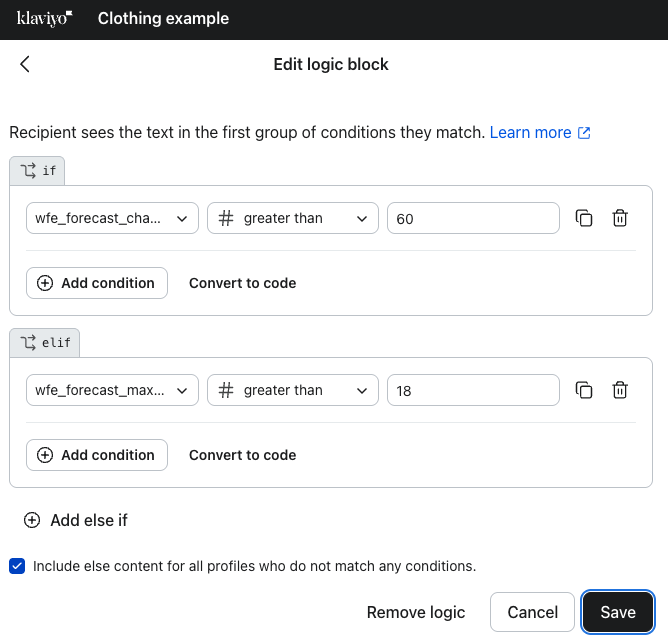
Building the logic in your email template
The privacy advantage
Weather is entirely contextual, it describes conditions in a location, not anything about an individual. There's no PII involved, no behavioural tracking, no consent complexity. At a moment when third-party cookies are being phased out and customers are more privacy-aware, weather is a rare personalisation signal that is simultaneously powerful and completely privacy-safe.
Weather For Email only fetches profiles address information from Klaviyo and uses this to calculate the weather forecast.
Where to start
Pick one campaign. The highest-value starting point for most brands is a temperature threshold trigger — something that fires when conditions cross a point that's meaningful for your product. A warm spell for outdoor brands. A frost alert for garden brands. A cold snap for home heating.
Set it up once. It runs automatically from then on, firing when conditions are right for each individual customer: not on a calendar date you decided three months ago.
